Valbury / AI Assistant
Valbury AI: defining a market assistant that knows what you own
This project shows my work in three areas:
- Product Requirements (PRD)
- Competitor Research
- Go-to-Market
- Project
- Valbury AI
- Role
- Product Intern
- Duration
- 2 weeks, Oct 2025
- Platform
- Valbury mobile app
- Status
- Proposed (PRD v1.0)
(I) Executive Summary
Defining an AI feature before anyone designs it
In October 2025, Valbury wanted to bring AI into its trading app. Before a single screen could be designed, someone had to answer: what should it do, for whom, and how would we know it worked? That was my job. I researched how other apps use AI, then wrote the PRD for an AI market assistant that answers questions using your own watchlist and portfolio.
On this project, I:
- Researched AI in six apps: chatbots, news summaries, trend signals and trading bots, screen by screen.
- Researched AI trading signals in four more: followed each from the home page to the buy button.
- Wrote the PRD: the problem, three personas and their use cases, nine features ranked by priority, a launch plan and success targets.
- Took it to review: with the Sr. UI/UX Designer, the Lead Product Manager and the VP of Product.
These efforts resulted in
10 apps
AI features researched, screen by screen
6
must-have features, out of 9 in the PRD
6
areas of success targets, from adoption to revenue
Here's how the story unfolds ▼
(II) Context
From a place to trade to an investment companion
Valbury Asia Futures started as a futures and forex app in Indonesia, and in late 2025 it was adding US stocks and crypto. That brings in a new kind of user: younger, newer to investing, and facing two markets that never close. Its long-term vision was to become more than a place to place trades: an investment companion that helps people decide.
AI was the obvious next step, but “add AI” isn't a feature. My part was the step before design: research what exists, pick the problem worth solving, and write it down clearly enough for designers, engineers and marketing to build from.
Research
AI in 10 apps (Oct 2–7)
PRD
problem, personas, features, targets (Oct 8–10)
Review
design, product and leadership
Next
design and build, by the team
(III) The Problem
Too much information, and none of it about you
19% of retail investors already use AI tools to pick or change their investments, up from 13% a year earlier. The top reason: it saves time on research (42%).
New investors drown in news, charts and jargon, and don't know which of it matters. Experienced ones lose hours switching between apps. Several trading apps already had AI assistants, but most answered general questions without knowing what the user actually owns.
- News, charts and jargon everywhere→beginners can't tell what matters→they hesitate, or guess
- Research is spread across many apps→hours switching between tools→less time deciding
- Other apps' AI answers general questions→it doesn't know your portfolio→answers feel surface-level
(IV) Competitor Research
6 apps: every one had a chatbot, almost none knew you
I did the competitor research. I picked six global trading and crypto apps with AI features and captured each feature screen by screen: chatbots, news summaries, trend projections and trading bots. Then I compared what each one could actually do.
| App A | App B | App C | App D | App E | App F | |
|---|---|---|---|---|---|---|
| AI chatbot | ✓ | ✓ | ✓ | ✓ | ✓ | ✓ |
| News and market summaries | ✓ | ✓ | ✓ | ✓ | ✓ | – |
| Trend or sentiment signals | ✓ | ✓ | – | ✓ | ✓ | – |
| Trading bot | – | – | – | ✓ | ✓ | – |
| Uses your own portfolio | – | – | – | – | – | ✓ |
- 01
A chatbot is table stakes.
All six had one. Having an AI assistant wouldn't set Valbury apart; what it knows would.
- 02
Almost none knew what you own.
Only one looked at the user's own trading. That became our angle: answers built on your watchlist and portfolio.
- 03
The best ones explain.
The strongest assistants explained their reasoning and taught beginners along the way, instead of just answering.
(V) AI Signals
A second idea: AI signals where you buy
We also explored AI trading signals: a short, AI-written explanation on an asset's page of why its price moved and what the sentiment is. I researched four more apps and followed the whole journey in each, from the home page to the purchase.
Home
a signals entry point
Signals
a list of assets with AI sentiment
Product page
the AI explanation beside the chart
Buy
one tap from the signal
In all four, the signal sat on the way to the trade, not in a separate AI corner. That pointed the same way as the chatbot research: AI is most useful where the decision happens.
(VI) Who It's For
Three investors, three different questions
The business wanted more engagement and retention, a way to stand out in Southeast Asia, and, later, a premium insights tier. Users wanted quick, plain answers about their own money. The PRD used the same three investors as Pocket, each with a new need:
Rina
The Learner, 26
Marketing executive, new to stocks and crypto
“Market news confuses me. I don't know which data matters.”
Andi
The Diversifier, 33
Software engineer with stocks and crypto
“I spend hours switching between charts, news and research sites.”
Siti
The Planner, 41
Senior teacher, long-term and low-risk
“I can't follow the jargon, or track how my portfolio is doing.”
(VII) How Might We
From questions to design rules
How might we answer questions about the user's own money?
Know what I own
Connect the assistant to the watchlist and portfolio, so every answer is personal.
How might we help beginners without slowing down experts?
Explain as you go
Plain answers first, with short explanations (“What is RSI?”) for anyone who wants them.
How might we bring people back without spamming them?
Come to them, on schedule
A daily or weekly AI Digest of what changed in their assets, instead of constant alerts.
(VIII) What the PRD Defined
Nine features, six must-haves
The PRD started with a conversational assistant and ranked every feature, so the team knew what the first version needed and what could wait:
| Feature | Priority | What it does |
|---|---|---|
| AI chatbot | Must | Answers questions about stocks, crypto and portfolios in plain language |
| Watchlist and portfolio link | Must | Personal answers and summaries, built on what you follow and own |
| Daily and weekly AI Digest | Must | Market highlights, top movers and changes in your assets |
| Sentiment and trend insights | Must | Simple bullish or bearish outlooks and volatility levels |
| Learning prompts | Must | Short explanations of terms, right in the chat |
| Performance summary cards | Must | A quick visual of an asset's change, with the AI's take |
| Personal notifications | Later | E.g. “Your AI Pocket grew 3% this week” |
| Follow-up actions | Later | Add to watchlist, buy or compare, straight from the chat |
| Stocks and crypto together | Later | Insights across both markets in one conversation |
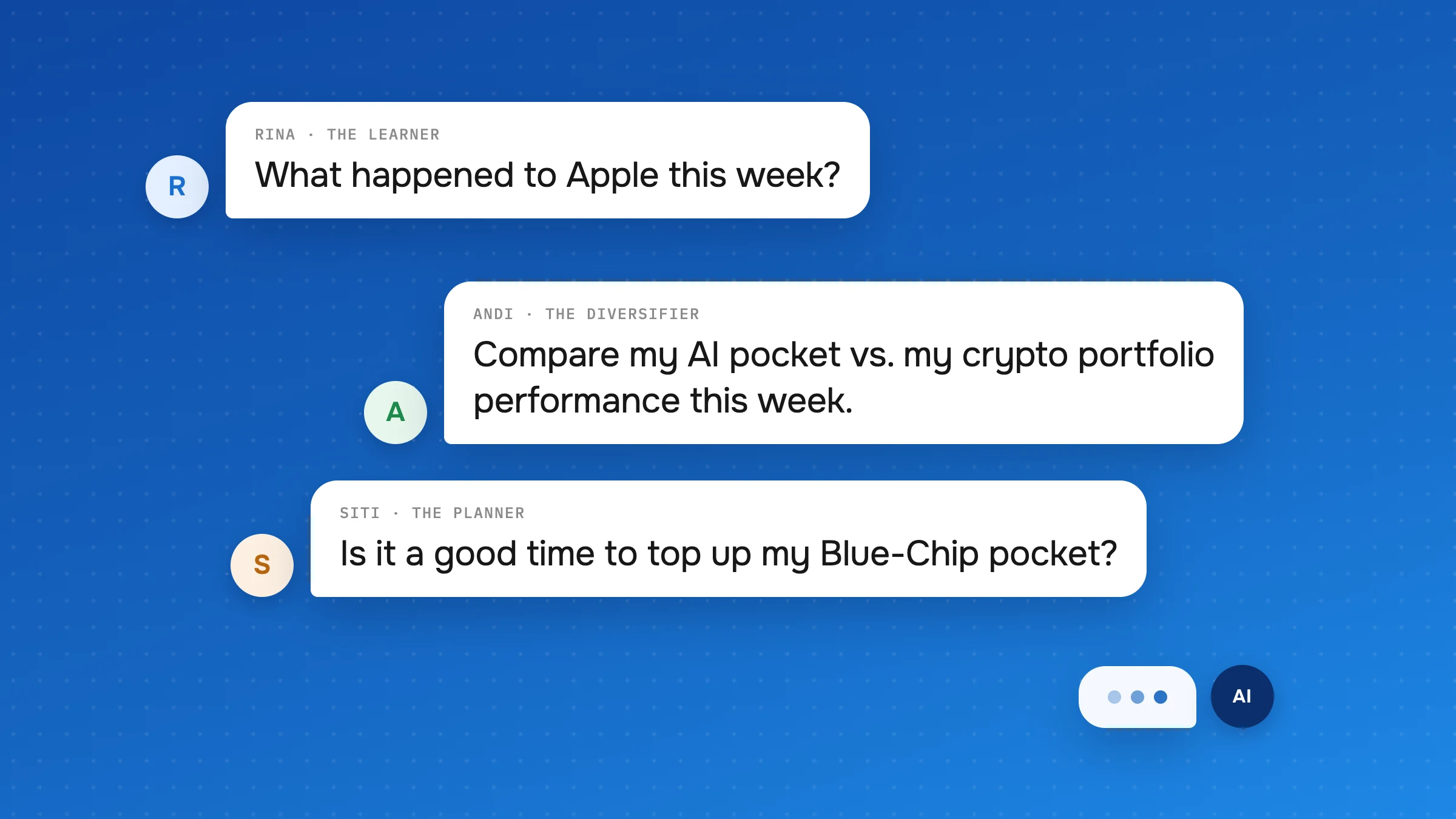
Rina asks
“What happened to Apple this week?” She gets the news, price move and sentiment in simple words, plus a short note on what moves tech stocks.
Andi asks
“Compare my AI pocket vs. my crypto portfolio this week.” He gets returns, volatility and sentiment side by side, in one place.
Siti reads
Her Weekly AI Digest: how her holdings did, with a plain risk note, before she decides whether to top up.
(IX) Launch Plan
Your personal AI investment companion
The launch plan aimed at retail investors aged 20 to 40 in Indonesia, Singapore and the Philippines who find research time-consuming, and positioned the assistant as “smart, fast, and tailored to your portfolio”.
In the app
A home banner, a prompt on the watchlist (“Ask AI what's trending today”), push notifications and an onboarding walkthrough.
Owned media
Blog posts, explainer videos and a tutorial series: “5 things you can ask your AI assistant”.
Social
Short clips of real questions answered by the AI, plus posts on AI in retail investing.
Incentives
7 days of premium insights free, and an invite-a-friend bonus.
(X) Success Metrics
How I defined success
I set targets for adoption, engagement, conversion, retention, revenue and satisfaction. Three headline targets:
Targets defined in the PRD
20–25%
of active users try the assistant within 3 months
40%
of AI users still active 2 months after first use
≥ 85%
positive satisfaction, with under 10% poor answers
| Area | Target defined in the PRD |
|---|---|
| Adoption | 20–25% of active users within 3 months; 10,000 sessions in beta |
| Engagement | 2–3 minute sessions; 40% chat twice a week; Digest open rate above 30% |
| Conversion | 25% more portfolio activity than non-users; 10% upgrade to premium (if offered) |
| Retention | 40% still active after 2 months; weekly returners up 15% a month |
| Revenue | 5–8% more trading volume; more use of other features, like Pocket |
| Satisfaction | 85%+ positive feedback; under 10% irrelevant or poor answers |
(XI) Reflection
What I learned
- 01
Research is the cheapest prototype.
Ten apps showed what was table stakes and where the gap was, before anyone spent a day designing.
- 02
Write for the people who build it.
Designers, engineers and marketing all read the same PRD. Use cases made the features concrete for all of them.
- 03
Next time, hear the questions first.
I'd collect the questions investors really ask, for example from support chats, before choosing what the assistant must answer.
Thanks to Valbury's Sr. UI/UX Designer, Lead Product Manager and VP of Product.

